


Blog


What Happens If You Put a Vape in Checked Luggage? A B2B Compliance Guide for Vape Brands
Written by EC-TIMES OEM Strategy Team

aviation safety, checked luggage, and vape battery compliance context
A purchase order is approved, the launch date is locked, and the first air shipment stalls because the supplier cannot produce a matching battery compliance file. That is why what happens if you put a vape in checked luggage is not just a travel question for the vape industry.
A vape device combines a lithium battery, heating element, e-liquid reservoir, and activation system in a compact body. That makes it highly sensitive to vape battery regulations, especially when products move through airlines, distributors, retail chains, and international customs channels. As a professional vape manufacturer, compliance is not only a traveler’s issue; it is a core competitive advantage for brand owners and procurement teams.
This article shows importers, private-label founders, wholesalers, and retail buyers how science, airline rules, and supplier controls separate a scalable vape OEM manufacturer from a risky vendor.
Regulatory note: All aviation and compliance references below are stated as of 2025. Buyers should verify the latest rules before shipment, launch, or market entry.
Need a compliant vape OEM partner? Talk to Our OEM Compliance Team → — share your target market, device type, and packaging requirements for a project-specific compliance review.
What Aviation Authorities Actually Say — And Why It Matters to Your Supply Chain
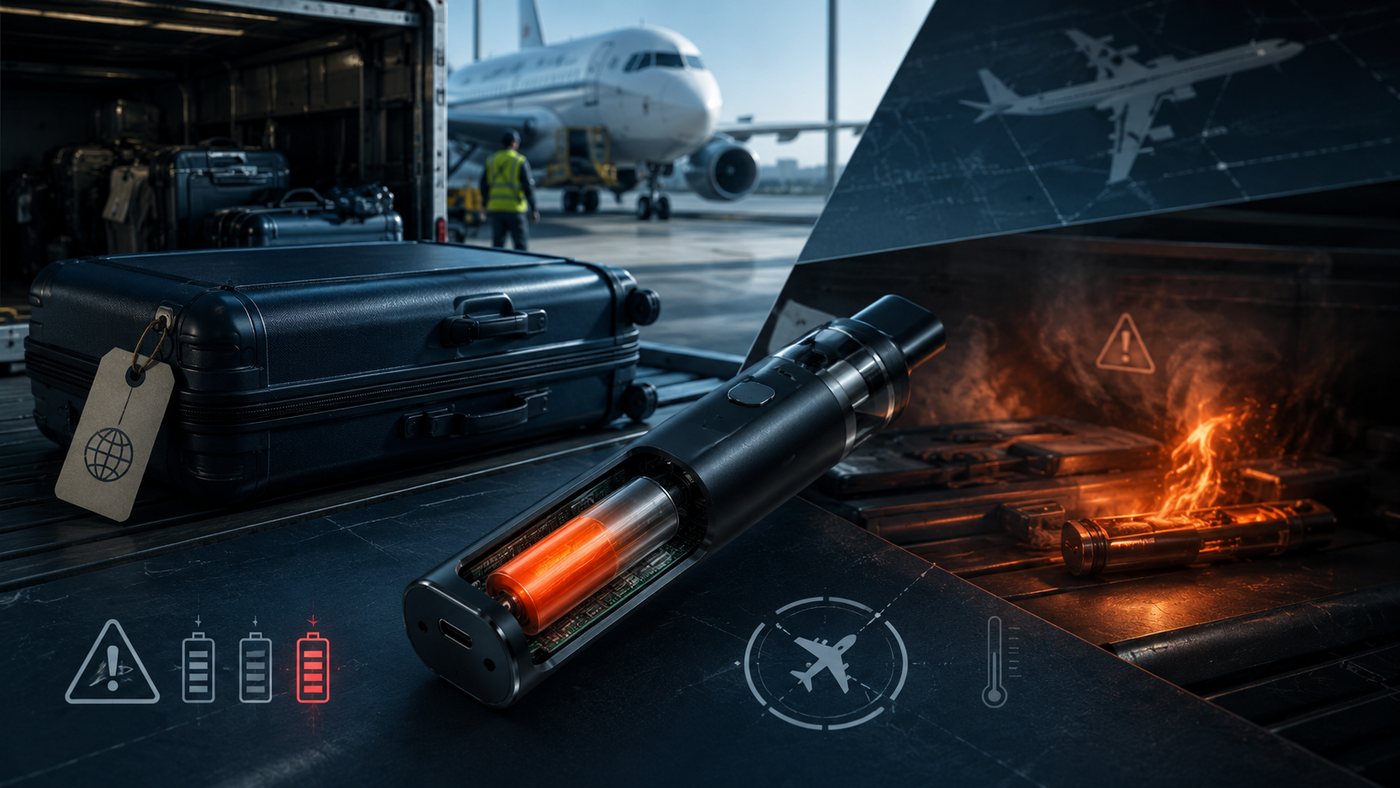
lithium battery risk and airline checked-luggage rules for vape products.
When a vape is placed in checked luggage, the issue is not the e-liquid alone. The real concern is the lithium-ion battery and heating circuit. Checked bags can face pressure changes, impact, compression, and temperature variation. If a device is crushed, accidentally activated, poorly insulated, or built with unstable cells, it can short-circuit and enter thermal runaway near a heating coil and liquid reservoir.
From an aviation-safety perspective, a vape in a checked bag creates a response problem. If a device overheats in the cabin, crew can respond quickly; if it overheats in the hold, smoke or fire is harder to isolate. CASA, Australia’s aviation safety authority, says vapes should be kept in the cabin. (casa.gov.au)
The main IATA vape rules are clear as of the 66th edition of the IATA Dangerous Goods Regulations, effective January 2025: e-cigarettes and personal vaporizers containing batteries are not permitted in checked baggage and are allowed in carry-on baggage only when protected against accidental activation. (iata.org) IATA’s 2025 lithium-battery passenger guidance also states that electronic cigarettes containing batteries must not be recharged onboard. (iata.org)
The United States follows the same direction: TSA allows electronic cigarettes and vaping devices in carry-on bags but not checked bags, while the FAA requires electronic smoking devices to travel on the person or in carry-on baggage. (tsa.gov) In the EU, EASA states that e-cigarettes must always be in hand baggage and notes ICAO-reported incidents involving e-cigarettes overheating in checked baggage. (easa.europa.eu)
Key Regulation Summary — As of 2025
|
Region / Authority |
Checked Luggage Rule |
B2B Relevance |
|
IATA |
E-cigarettes and personal vaporizers with batteries: No checked baggage; carry-on only |
Baseline for global lithium battery air travel and airline acceptance |
|
United States: TSA / FAA |
Vapes: not allowed in checked bags; battery and accidental activation controls apply |
Impacts U.S. importers, retail chains, and sample shipments |
|
EU / EASA |
E-cigarettes must be in hand baggage; onboard charging is forbidden |
Relevant for CE, RoHS, and EU channel risk reviews |
|
Australia / CASA |
Vapes and e-cigarettes should never be checked |
Useful for distributor education and packaging warnings |
|
Southeast Asia |
Rules vary. Thailand’s CAAT lists vapes as carry-on only, while Singapore prohibits importing imitation tobacco products such as electronic cigarettes |
E-cigarette import compliance must be checked country by country (caat.or.th) |
Key takeaway: Aviation authorities worldwide classify vapes as carry-on-only items because of lithium battery fire risk in cargo holds. For brands, this makes battery engineering and documentation a baseline product requirement — not a shipping afterthought.
Why Your Vape Supplier's Battery Files Could Be Your Biggest Import Risk
For a brand owner, the question is not only “Can a consumer take this product on a plane?” The deeper question is whether the product was engineered, certified, packed, and documented well enough to survive airline, customs, and retail compliance scrutiny. A disposable vape checked bag issue becomes a supply-chain issue when a buyer asks for battery files, packaging warnings, or dangerous-goods transport documents before approving a purchase order.
Aviation rules push vape product design in several ways. Battery capacity must be controlled and clearly specified, even when it is below passenger lithium battery thresholds. Buyers still need accurate Wh calculation, cell traceability, and stable sourcing. Activation protection also matters: recessed buttons, draw-activation reliability, firmware cut-off, short-circuit protection, and insulation design all reduce accidental heating risk. Leak resistance is another safety factor because liquid migration can corrode contacts during transport.
For export-focused brands, vape compliance certification is not optional. A credible file should include UN38.3 battery evidence, battery test summaries, MSDS or SDS, RoHS documentation, and CE or UKCA documentation where applicable. PHMSA explains that lithium batteries must be subjected to design tests under UN Manual of Tests and Criteria subsection 38.3. (phmsa.dot.gov) The European Commission states that RoHS restricts hazardous substances in electrical and electronic equipment. (environment.ec.europa.eu)
This is where procurement risk appears. Some suppliers can provide attractive samples but cannot support full certification, batch traceability, airline packaging marks, or market-specific documentation. Smaller factories may rely on generic battery files that do not match the actual cell used in production. Working with an OEM factory that has a complete compliance system turns regulation from an afterthought into a product-development requirement.
Key takeaway: Compliance certification is not a checkbox — it is a buyer-protection system. A supplier who cannot produce matched, batch-traceable UN38.3 and RoHS files is a supply-chain liability, regardless of sample quality.
How We Engineer Compliance Into Every OEM Project

OEM compliance engineering, battery testing, certification files, and export packaging review
As a Shenzhen-based vape OEM manufacturer, we treat aviation compliance as part of product engineering, not as paperwork added at the end of production. Our export workflow is built for buyers across North America, Europe, Australia, the Middle East, and Southeast Asia, where airline rules, customs expectations, and retail compliance checks often overlap. For each OEM or ODM project, we define the battery platform, device structure, packaging method, and documentation scope before tooling or mass production begins.
Our battery safety process focuses on traceable cell sourcing, controlled welding parameters, aging tests, charge-discharge checks, and production-line sampling. For rechargeable devices, we verify USB charging behavior, protection IC performance, and thermal response. For disposable projects, we focus on insulation, air-path sealing, contact stability, and activation sensitivity because airline rules for e-cigarettes are based on risk scenarios that start with small design failures.
For documentation, we maintain model-specific UN38.3, CE, RoHS, and MSDS/SDS files for confirmed production SKUs, with documents linked to battery specifications, PCBA versions, and production batches where applicable. For air freight, vape products with installed lithium-ion batteries are commonly reviewed under UN3481 categories, including IATA PI 966/967 depending on whether batteries are packed with equipment or contained in equipment. IATA’s battery guidance requires lithium battery test summaries to be available for relevant batteries and powered equipment. (iata.org)
Packaging is another compliance layer. We design inner trays, insulation, carton structure, label areas, and master carton specifications around product safety and freight acceptance. For private-label clients, MOQ, sample lead time, and mass-production schedule are confirmed project by project based on device platform, packaging complexity, certification scope, and component availability. This prevents buyers from building launch plans around unrealistic promises.
Shenzhen’s supply-chain advantage supports this work. Battery vendors, plastics, ceramics, PCBA partners, packaging suppliers, and testing labs are close enough for fast iteration and corrective action. We use approved supplier lists, locked BOMs, incoming-material inspection, in-house aging checks, and engineering-change control to verify critical components before final assembly.
For buyers comparing a long-term vape brand partner, we can review product goals, target markets, packaging needs, and certification expectations before quotation. Learn more about our compliance documentation on the Our Certifications page, or reach our project team through the Contact Us page.
5 Questions Every Serious Buyer Should Ask Before Placing a Vape Order

procurement checklist meeting between overseas buyer and vape OEM supplier team
Use this procurement checklist before selecting a custom vape supplier. It separates a scalable OEM partner from a sample-only vendor.
1. Can you provide matching UN38.3, MSDS/SDS, CE, RoHS, and battery files for the exact production model?
Documents should match the battery model, device structure, and SKU being ordered. We provide model-matched UN38.3, MSDS/SDS, CE, and RoHS documentation for confirmed production SKUs, tied to battery specifications and batch records.
2. What are the battery capacity, Wh rating, cell supplier, and protection design?
A serious supplier should explain capacity, voltage, Wh calculation, and protection design without vague language. We disclose battery specs at quotation stage, including cell supplier, nominal voltage, Wh rating, protection IC model, and activation-control design.
3. Can retail packaging and master cartons be customized for export compliance?
Private-label packaging should consider warning text, barcode placement, transport marks, market language, and carton durability. We customize retail packaging, inner trays, warning labels, barcode areas, and master carton layouts according to the destination market and shipment route.
4. How do you support e-cigarette import compliance in different markets?
The U.S., EU, Australia, and Southeast Asia do not operate under one single rulebook. We prepare market-specific document packs covering UN38.3, MSDS/SDS, CE, RoHS, UKCA where applicable, and packaging information, and we flag compliance gaps before production approval.
5. What happens after shipment if a distributor requests additional compliance evidence?
A reliable supplier should provide document support, batch traceability, corrective action, and engineering feedback. We keep batch-level production and document records under our internal retention policy and support distributors with compliance evidence after shipment.
A qualified OEM partner should answer these questions before production begins. Early compliance review can save weeks of rework later.
Not sure if your current supplier meets these standards? Request a Supplier Compliance Review → — share your product specs and we will flag documentation gaps before your next order.
What Happens If You Put a Vape in Checked Luggage — The B2B Lesson
What happens if you put a vape in checked luggage is a simple keyword with a serious B2B lesson. Aviation authorities restrict vapes because lithium batteries, heating elements, and accidental activation can create fire risk where response is difficult. For vape brands, compliance is not a cost burden. It is a brand moat.
The strongest importers and distributors do not wait for problems at customs, airports, or retail audits. They qualify suppliers early, demand complete certification, and design products around global safety expectations from day one.
Contact Us for a Custom OEM Quote →
FAQ
Can you put a disposable vape in checked luggage?
No. A disposable vape should not be placed in checked luggage under mainstream aviation safety rules as of 2025. IATA, FAA, TSA, EASA, and many national aviation authorities treat battery-powered e-cigarettes as cabin-only items because they contain lithium batteries and heating elements. For B2B buyers, the important point is product risk management. Disposable products often have sealed batteries, compact wiring, and limited user access, so the manufacturer must control the cell source, insulation, sealing, and activation design. A brand selling disposable vapes internationally should ensure that every SKU has matching UN38.3 evidence, MSDS/SDS documentation, carton specifications, and packaging warnings.
What is the airline rule for vape batteries?
The airline rule for vape batteries is that e-cigarettes and vaping devices with lithium batteries are generally restricted to carry-on baggage or on-person carriage, not checked baggage. Spare lithium batteries must also be protected against short circuit and carried in the cabin. The FAA states that electronic smoking devices must be carried on the person or in carry-on baggage, with measures to prevent accidental activation, and that onboard recharging is not permitted. (faa.gov) For brands and distributors, this rule makes Wh rating, battery supplier, protection circuit, and UN38.3 status essential pre-production checks.
Are vapes allowed on international flights?
Vapes may be allowed on some international flights only under airline, aviation-authority, and destination-country restrictions; they are not universally accepted. IATA notes that some airlines do not allow e-cigarettes or vapes at all, while others permit them only in carry-on baggage and prohibit use or charging during flight. (iata.org) Country rules can be stricter than airline rules. Singapore, for example, lists imitation tobacco products such as electronic cigarettes among items not allowed to be imported. (ica.gov.sg) For B2B importers, route planning and market review must happen before launch.
How do vape manufacturers ensure battery safety for air transport?
Vape manufacturers ensure battery safety for air transport by combining battery qualification, device engineering, production control, and documentation. At component level, this means using traceable lithium cells, verifying Wh rating, checking protection circuits, and confirming UN38.3 evidence. UN38.3 testing covers altitude simulation, thermal exposure, vibration, shock, short circuit, overcharge, and forced discharge. (tuvsud.com) In our OEM process, we also review packaging insulation, carton structure, and battery-document consistency before export. This reduces airline rejection and missing-file risk.
What certifications should a vape OEM supplier have?
A vape OEM supplier should provide documentation that matches the actual product, battery, and target market. At minimum, buyers should ask for UN38.3, MSDS/SDS, battery specifications, RoHS, CE or UKCA documents, and transport packaging information. For EU-oriented channels, RoHS compliance is important because electrical and electronic equipment must meet hazardous-substance restrictions unless excluded. (environment.ec.europa.eu) Buyers should also review batch traceability, production QC records, packaging compliance, and after-sales document support. A strong OEM supplier connects certification, engineering, procurement, and shipment support in one auditable system.