


Blog


How to Import Vapes from China Without Leakage, Customs Delays, or OEM Mistakes
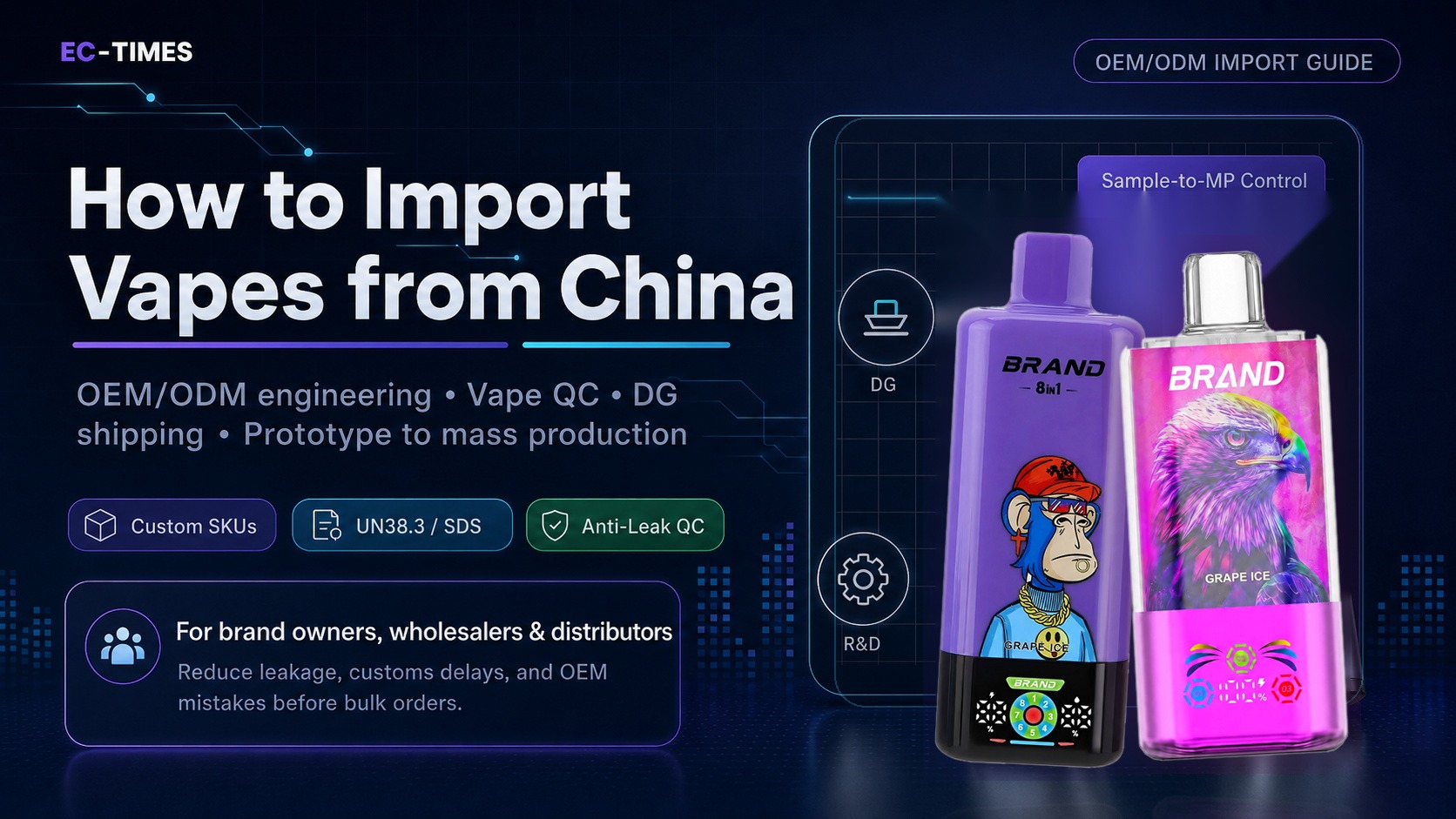
EC-TIMES B2B guide on how to import vapes from China with OEM ODM engineering, vape QC, DG shipping, and custom vape products
Why Serious Vape Importers Still Choose China and Shenzhen
Importing vapes from China is easy until the first bulk shipment exposes the real problems: leaking tanks, unstable flavor, weak batteries, delayed tooling, missing DG shipping documents, or a supplier that cannot explain what went wrong.
For brand owners, wholesalers, and distributors, the real question is not only how to import vapes from China. The real question is how to build a China vape supply chain that protects your launch schedule, margin, compliance position, and brand reputation.
Shenzhen remains a core manufacturing base because the complete vape ecosystem is concentrated in one region: product design, structure engineering, mold tooling, coil development, battery sourcing, e-liquid flavor matching, packaging, assembly, QC, and export logistics. Research on Shenzhen’s e-cigarette industrial cluster describes the city as the center of Chinese e-cigarette production, with a complete business ecosystem of producers, suppliers, sellers, and related enterprises. [Source: MDPI - add external hyperlink]
But this concentration creates another challenge: many suppliers look similar online. Some are catalog sellers. Some are trading companies. Some can print your logo. Fewer can take a product idea, challenge the structure, match the coil with the e-liquid, build testable samples, control tooling, and keep mass production aligned with the approved sample.
That is where EC-TIMES positions itself.
We are not another catalog supplier. EC-TIMES helps vape brands launch faster, build distinctive SKUs, and control the transition from prototype to mass production. Our team combines brand-side thinking with factory execution: OEM development for faster first launches, ODM development for differentiated products, 0-to-1 R&D support, and in-house manufacturing for better batch control.
This guide is written for:
Vape brand owners planning a private-label or ODM product line
Wholesalers importing large-volume disposable, rechargeable, or pod-system vapes
Distributors who need stable supply, repeatable quality, and customs-ready documents
Companies comparing China vape OEM manufacturers for long-term cooperation
If you are only sourcing a few retail pieces, this guide is probably not for you. If you are building a scalable vape business, every section below matters.
Before You Import: The 5 Controls Every B2B Buyer Needs
A strong vape import program depends on five controls.
|
Control Area |
What It Protects |
|
Hardware control |
Flavor consistency, puff performance, battery stability, leakage rate |
|
OEM/ODM engineering control |
Product differentiation, tooling feasibility, launch timeline |
|
Quality control |
Defect rate, after-sales cost, batch consistency |
|
Logistics and compliance control |
Customs clearance, DG shipping acceptance, market entry |
|
Commercial control |
MOQ, payment safety, IP ownership, supply continuity |

Five B2B controls before importing vapes from China including hardware, OEM ODM engineering, quality, logistics, and commercial control
Cheap pricing cannot compensate for weak control. A device that saves a few cents per unit but creates leakage claims, customs holds, or high return rates is not cheaper. It simply moves the cost from purchasing to after-sales.
At EC-TIMES, we usually help buyers choose between two routes before discussing final pricing.
|
Route |
Best For |
Why It Works |
|
OEM / Private Label |
Faster launch, market testing, lower development risk |
Start from proven models and customize logo, packaging, colors, and flavors. |
|
ODM Development |
Brand differentiation, owned SKU, long-term competitiveness |
Develop custom appearance, structural features, tooling, artwork, and flavor direction. |
The right route depends on your market, launch deadline, budget, MOQ plan, compliance requirements, and how much differentiation your brand needs.
Step 1: Understand Vape Hardware Before You Request a Quote

Vape hardware platform diagram showing mouthpiece, anti-leak tank, mesh ceramic coil, battery PCB, and airflow channel for OEM customization
A serious China vape OEM/ODM factory should not quote before understanding your hardware platform. For large buyers, the first negotiation should be technical, not only commercial.
Mesh Coil vs. Ceramic Coil: What Importers Should Specify
Mesh coil uses a larger heating surface to deliver fast ramp-up, even heat distribution, and clean flavor release. For fruit, ice, mint, beverage, and dessert profiles, mesh coil often gives a fuller top-note expression.
But “mesh coil” is not a complete specification. Importers should ask for resistance tolerance, mesh material and geometry, cotton density, e-liquid viscosity, output voltage curve, and puff-test records.
|
Parameter |
Why It Matters |
|
Resistance tolerance |
Controls vapor output, power consumption, and flavor stability |
|
Mesh material and geometry |
Affects heat distribution and ramp-up speed |
|
Cotton density |
Controls wicking speed and dry-hit risk |
|
E-liquid viscosity |
High VG or heavily sweetened formulas need adjusted wicking |
|
Output voltage curve |
Determines whether flavor stays stable from full battery to low battery |
|
Puff-test record |
Shows whether the coil survives repeated use under real conditions |
Ceramic coil is different. A porous ceramic body can offer durability, dimensional stability, and good heat resistance. It is useful when the project prioritizes long shelf life, stable wicking, or certain oil formulations. The trade-off is that ceramic may soften some flavor top notes if pore structure, temperature, airflow, and e-liquid formula are not tuned together.
At EC-TIMES, coil selection is treated as part of the product definition, not a sales label. For custom projects, our engineering and flavor teams review the coil, tank structure, output curve, and e-liquid direction together before confirming the sampling route.
Battery Capacity, Safety, and Real Documentation
Battery capacity is one of the most abused claims in low-end vape sourcing. For importers, nominal mAh is only the beginning. Ask for the cell model, supplier information, rated capacity, capacity tolerance, internal resistance range, discharge curve, low-temperature discharge behavior, PCB protection design, charging current and cut-off voltage, UN38.3 test report or test summary, and battery SDS/MSDS.
Lithium-ion batteries are classified as Class 9 miscellaneous dangerous goods under IATA lithium battery guidance. When installed in equipment or packed with equipment, lithium-ion batteries may fall under UN3481 classifications, depending on the shipping configuration. IATA also states that lithium battery test summaries must be made available according to the UN Manual of Tests and Criteria, Part III, subsection 38.3. [Source: IATA - add external hyperlink]
Do not accept a random UN38.3 document that does not match the production battery. For large orders, the battery model in the test report, BOM, purchase record, and production lot should be consistent.
Tank Structure, Airflow, and Anti-Leak Engineering
Leakage is rarely caused by one part. It is usually a system failure. A vape tank must balance oil storage, air pressure, capillary action, silicone compression, filling tolerance, mouthpiece condensation, and temperature change.
A qualified OEM/ODM factory should review oil chamber geometry, sealing plug hardness, silicone compression ratio, headspace after filling, airflow path separation from the oil chamber, mouthpiece condensation channel, ultrasonic welding or snap-fit reliability, and vertical, side-position, and inverted storage performance. Anti-leak design starts at structure engineering. It cannot be fixed by better packaging alone.
Step 2: How to Identify a Real China Vape OEM/ODM Factory Remotely

Remote supplier verification infographic comparing a catalog seller with a real China vape OEM ODM factory using DFM CAD BOM QC and tooling proof
You may not visit China before placing the first serious order. That does not mean you must rely on showroom videos or sales claims. A trading company can forward your request. A factory can challenge it, improve it, and make it manufacturable.
A Real Factory Starts with Engineering Questions
Send a structured project brief and observe the response. A weak supplier usually replies with catalog links, MOQ, and price. A real China vape OEM manufacturer asks about target market, product type, oil capacity, puff target, coil preference, battery capacity, charging method, flavor direction, nicotine strength, airflow preference, packaging format, compliance requirements, monthly forecast, and launch deadline.
If you provide a sketch, sample, or 3D file, the factory should be able to discuss tooling risks, wall thickness, draft angle, sealing structure, airflow path, assembly sequence, and mold-cavity strategy. That is the difference between sourcing and engineering.
EC-TIMES was founded by a team with Alibaba experience, but we do not operate like an order-taking factory. Our workflow is built around customer-first project communication, fast requirement clarification, and cross-functional follow-up from briefing to delivery. For overseas buyers, that means fewer vague answers and a clearer path from product idea to testable sample. 【About EC-TIMES】
Remote Supplier Verification Checklist
|
What to Ask |
What a Real Factory Should Provide |
|
Can you review my concept before quoting? |
DFM comments and technical risk points |
|
Can you explain your anti-leak structure? |
Sealing logic, test method, and sample results |
|
Can you match flavor with coil and output curve? |
Hardware-based flavor testing, not only lab tasting |
|
Can you provide battery documents? |
UN38.3, SDS/MSDS, cell model, and test summary |
|
Can you control batch consistency? |
IQC/IPQC/OQC records and AQL inspection plan |
|
Can you protect my custom design? |
NDA, file-control process, tooling ownership terms |
|
Can you support pilot production? |
EVT/DVT/PVT or equivalent validation process |
A supplier that only says “no problem” is a problem.
Step 3: The OEM/ODM Customization Process from Concept to Mass Production

Vape OEM ODM customization process from product brief, ID design, structure, flavor matching, tooling, prototype, pilot run, to mass production
A mature vape OEM/ODM project should move through controlled engineering stages. Skipping stages may save two weeks and damage an entire launch.
1. Requirement Mapping
The first stage is product definition. Your supplier should confirm target country or region, product type, oil capacity, nicotine strength, coil type, resistance range, battery capacity, charging method, flavor SKU count, packaging, warning labels, barcode requirements, MOQ, monthly forecast, and expected launch date.
China’s Administrative Measures for E-Cigarette Management state that e-cigarette products made only for export should comply with the laws, regulations, and standards of the destination country or region. [Source: China Administrative Measures - add external hyperlink]
For EC-TIMES projects, this stage decides whether the buyer should use an OEM route or a full ODM route. If your goal is a faster first launch, OEM development may be safer. If your goal is brand ownership and long-term differentiation, ODM development is the better route.
2. ID Design and CMF
Industrial design defines shape, grip, display area, mouthpiece angle, brand language, and user interaction. CMF covers color, material, and finish. This is where a private-label product starts becoming a brand asset rather than another catalog SKU.
A serious factory should provide 2D concept sketches, 3D renderings, CMF recommendations, material options, production feasibility notes, and cost impact by finish and structure. A beautiful rendering that cannot be molded consistently is not a product. It is a risk.
3. Structure Engineering
Structure engineering converts the design into manufacturable parts. This stage controls oil chamber layout, battery positioning, PCB location, sensor channel, sealing structure, filling port, airflow path, mouthpiece fit, and assembly sequence.
EC-TIMES supports 0-to-1 R&D for buyers who have a rough concept but not a production-ready design. Our 37-member R&D team covers industrial design, structure engineering, artwork, and flavor development, turning early ideas into testable samples that can be optimized for mass production.
4. E-liquid Flavor Matching with Coil and Output Curve
Flavor is not only a formula issue. It is a hardware-formula interaction. The same mango, mint, tobacco, cola, or berry profile can taste different on mesh and ceramic coils. It can also change after standing time, high-temperature storage, or long-distance shipping.
For serious OEM projects, flavor confirmation should be done with the actual coil, actual tank structure, actual power curve, actual airflow, actual filling volume, standing-time samples, and repeated puff testing. Lab tasting is useful, but final approval should come from filled device samples.
5. Tooling, Prototyping, and Sample Confirmation
|
Stage |
Main Output |
|
Concept review |
Product direction and risk list |
|
3D prototype or CNC sample |
Size, grip, appearance, basic structure check |
|
DFM review |
Mold feasibility, wall thickness, draft angle, assembly logic |
|
Mold design |
Tooling plan and cavity strategy |
|
T0/T1 trial |
First molded parts and correction list |
|
Functional sample |
Coil, battery, airflow, sealing, and flavor confirmation |
|
Pilot run |
Small-batch validation before mass production |
|
Mass production |
Frozen BOM, golden sample, QC plan, shipment schedule |
Existing-model private label can move faster. A full ODM project with new ID, new structure, tooling, flavor matching, reliability validation, packaging, and pilot run requires a longer timeline. A responsible supplier will explain the timeline logic instead of promising an unrealistic launch date.
6. EVT, DVT, PVT, and Mass Production
For large-volume buyers, a staged validation model reduces risk. EVT checks whether the engineering concept works. DVT checks whether the design survives reliability testing. PVT checks whether production can repeat the result at scale. Mass production should begin only after the golden sample, BOM, packaging files, QC standards, inspection criteria, and shipment documents are frozen.
Step 4: Vape Quality Control That Protects Your Bulk Order

Vape quality control infographic showing high low temperature testing, gravity anti-leak testing, draw resistance, battery charge discharge, AQL and traceability
The biggest risk in vape importing is not receiving a bad sample. It is approving a good sample and receiving unstable mass production. This is why in-house manufacturing matters.
EC-TIMES operates its own 3,700 m² factory with ISO/GMP clean workshops and multi-step inspections. The purpose is not only to make samples look good. The purpose is to help mass production stay aligned with approved samples.
IQC: Control the Materials Before Assembly
Incoming Quality Control should cover batteries, coils, plastics, silicone parts, PCBs, packaging materials, and e-liquid. Key checks include battery voltage, capacity, internal resistance, appearance and documents; coil resistance tolerance; cotton or ceramic consistency; injection-molded dimensions; silicone hardness; PCB function; e-liquid COA; and packaging accuracy.
IPQC and OQC: Test What Actually Fails in the Market
|
Test |
Purpose |
|
Gravity anti-leak test |
Checks leakage in upright, side, and inverted positions |
|
High/low-temperature test |
Simulates warehouse, container, and seasonal transport conditions |
|
Aging test |
Detects delayed leakage, condensation, and flavor drift |
|
Puff test |
Confirms vapor output, coil saturation, and flavor curve |
|
Draw resistance test |
Controls airflow consistency across the batch |
|
Battery charge/discharge test |
Verifies battery performance and protection logic |
|
Charging temperature test |
Reduces rechargeable-device safety complaints |
|
Drop and vibration test |
Simulates handling and transport stress |
|
Filling-weight inspection |
Prevents underfill, overfill, and pressure imbalance |
|
Packaging inspection |
Prevents carton, label, barcode, and warning-label errors |
Batch Traceability and AQL Inspection
Large buyers should require batch traceability. Each shipment should connect finished goods to battery batch, coil batch, e-liquid batch, PCB batch, production line, production date, QC inspection record, and carton and batch code.
Step 5: Logistics and Customs Clearance for Vapes from China

Vape DG shipping and customs clearance document stack with UN38.3, SDS MSDS, invoice packing list, DG docs, and product specification
Vape logistics is not ordinary consumer electronics logistics. The lithium battery inside the device changes the shipping profile.
Why Vape Shipping Is Not Ordinary Electronics Shipping
IATA guidance states that lithium batteries can be carried by air depending on configuration and Watt-hour rating for rechargeable batteries, and it provides guidance for shippers, freight forwarders, ground handlers, airlines, and passengers to understand battery transport requirements. [Source: IATA - add external hyperlink]
For vape importers, the exact shipping route depends on device type, battery capacity, battery installation method, quantity per package, packaging method, air or sea freight, destination country, carrier acceptance rules, and whether the product is filled with e-liquid.
Do not misdeclare vapes as chargers, toys, LED lights, or plastic accessories. Misdeclaration can cause customs holds, carrier penalties, seizure, and long-term risk for both supplier and importer.
Documents Importers Should Prepare
|
Document |
Why It Matters |
|
Commercial invoice |
Customs valuation and product description |
|
Packing list |
Carton count, quantity, weight, dimensions |
|
Sales contract or purchase order |
Trade record |
|
Product specification sheet |
Hardware, battery, oil capacity, packaging details |
|
Battery UN38.3 test report or test summary |
Lithium battery transport acceptance |
|
Battery SDS/MSDS |
Battery chemical safety and transport information |
|
E-liquid SDS/MSDS |
Chemical safety information where applicable |
|
Dangerous goods declaration |
Required for certain DG shipments |
|
DG appraisal or transport identification report |
Often requested by forwarders or carriers |
|
Certificate of origin |
Required by some buyers or customs processes |
|
Label and packaging files |
Destination-market compliance review |
|
Product registration or authorization record |
Required in certain regulated markets |
OSHA describes Safety Data Sheets as documents that communicate chemical properties, hazards, protective measures, and safety precautions for handling, storage, and transportation. [Source: OSHA - add external hyperlink]
The manufacturer can support documents, but the importer of record should confirm final HS code, customs classification, local tax obligations, labeling, and product authorization with its own broker or regulatory consultant.
EU, UK, and US Compliance Risks
Compliance differs sharply by market. In the EU, Article 20 of the Tobacco Products Directive lays down rules for consumer e-cigarettes, including nicotine concentration, tank and container volume, child-resistant and tamper-evident design, refill mechanisms, ingredient purity, consistent nicotine delivery, and product notification. [Source: European Commission - add external hyperlink]
In the UK, businesses have been prohibited from selling or supplying single-use vapes since 1 June 2025. The ban applies to online and shop sales and to vapes with or without nicotine, while reusable vapes can still be sold and supplied. [Source: GOV.UK - add external hyperlink]
In the United States, FDA updated Import Alert 98-07 in January 2025. FDA states that unauthorized e-cigarette products imported into the US may be subject to detention without physical examination and refused admission, and that a pending application does not create a legal safe harbor to distribute or sell an unauthorized product. [Source: FDA - add external hyperlink]
For B2B buyers, this means product design must follow the destination market from day one. A device that works commercially in one region may be blocked in another because of tank capacity, nicotine strength, disposability, labeling, packaging, tax rules, or authorization status.
MOQ, Lead Time, Payment, and Supply Chain Security
A serious vape import program is not built on price alone.
MOQ: Ask for the Logic, Not Only the Number
MOQ depends on device type, customization depth, packaging complexity, number of flavors, e-liquid batch size, color and surface finish, whether new tooling is required, monthly forecast, and regulatory labeling requirements. A supplier that explains MOQ logic is safer than one that gives an unrealistically low MOQ for every project.
Lead Time: Manage the Critical Path
|
Project Type |
Typical Scope |
Lead-Time Risk |
|
Private label |
Existing device, logo, packaging, flavor selection |
Packaging, available stock, flavor confirmation |
|
Semi-custom |
Existing platform with color, airflow, mouthpiece, flavor tuning |
Sample revisions and component availability |
|
Full ODM |
New ID, structure, tooling, coil/flavor matching, validation |
Tooling correction, reliability testing, pilot-run issues |
Large buyers should manage backward from the launch date. Freeze packaging early. Confirm compliance before tooling. Approve golden samples before mass production. Book DG-compatible freight before the cargo is ready.
Payment and Supply Chain Security
For first orders, avoid paying 100% upfront to an unknown supplier. Use milestone-based controls: deposit after project confirmation, tooling payment after DFM approval, sample approval before mass production, balance after inspection, and shipment release after document confirmation.
Protect your brand with NDA, tooling ownership terms, approved BOM, golden sample sealing, AQL inspection agreement, batch traceability records, warranty and after-sales responsibility, and backup plans for battery cells, coils, packaging, and critical components. A reliable factory will discuss risks early. A weak supplier hides risks until production stops.
Work With EC-TIMES: From Idea to Testable Sample to Stable Bulk Production

IMAGE SEO TO ADD: filename: ec-times-free-vape-prototype-evaluation-oem-odm-cta.jpg | alt text: EC-TIMES free OEM ODM feasibility review for custom vape SKU development with prototype evaluation and mass production support
Importing vapes from China is not only a sourcing decision. It is a product engineering, quality control, compliance, and supply-chain decision. EC-TIMES is built for buyers who need more than a catalog supplier.
For faster launches, our OEM development team helps brands customize proven models with logo, packaging, colors, and flavors. This route is suitable when you need a private-label vape line with lower upfront risk and a shorter development cycle.
For stronger differentiation, our ODM development team supports custom appearance, structural features, tooling, artwork, and flavor development. This route is suitable when you want a SKU your brand can own, not another product competing only on price.
For 0-to-1 projects, our 37-member R&D team helps turn rough concepts into testable samples. For production, our 3,700 m² in-house factory, ISO/GMP clean workshops, and multi-step inspections help keep mass production aligned with the approved sample.
FAQ: Importing Vapes from China
How do I find a reliable vape OEM manufacturer in China?
Look beyond catalog price. Ask for DFM feedback, battery documentation, coil specifications, leakage test standards, sample revision records, batch traceability, and AQL inspection terms. A real OEM factory should discuss engineering risks before quoting.
What documents are needed to ship vapes from China?
Common documents include commercial invoice, packing list, product specification sheet, battery UN38.3 test report or test summary, battery SDS/MSDS, e-liquid SDS/MSDS where applicable, dangerous goods declaration when required, DG appraisal if requested by the forwarder, and destination-market compliance files.
Are vapes dangerous goods for shipping?
Vape products usually contain lithium-ion batteries. IATA classifies lithium and sodium-ion batteries as Class 9 dangerous goods, and lithium-ion batteries contained in equipment or packed with equipment may fall under UN3481 classifications depending on the shipping setup. The final classification should be confirmed with a qualified freight forwarder.
How long does a custom vape OEM/ODM project take?
Private-label projects can move faster because they use an existing device platform. Semi-custom and full ODM projects take longer because they require ID design, structure engineering, tooling, prototyping, validation, packaging confirmation, pilot run, and mass production. Exact timing depends on customization depth, sample revisions, and compliance requirements.
What should I check before placing a bulk vape order?
Check the sample, coil performance, leakage testing, draw resistance, battery charging, packaging accuracy, compliance documents, AQL terms, batch traceability, payment milestones, and after-sales responsibility before mass production starts.
References & Hyperlink Checklist
Add or preserve these external hyperlinks when uploading the blog to your CMS:
• MDPI
• IATA 2026 Lithium Battery Guidance
• China Administrative Measures for E-Cigarette Management
• European Commission Electronic Cigarettes
• FDA Import Alert 98-07 Update
Internal links to add: EC-TIMES homepage, OEM/ODM service page, QC capability page, factory/about page, contact/form page, and optional QC Checklist download page.