


Blog


How Long Does a Vape Last? ——A Technical Breakdown for Brands and Buyers
Written by EC-TIMES OEM Strategy Team
When a buyer asks how long does a vape last, a simple number feels useful. It is also where bad sourcing decisions begin.
A puff-count claim can sell a SKU into retail. It does not prove the unit will survive real-world draw behavior, storage, batch variance, and consumer handling. One device can fail early because the cell drops below activation voltage. Another can keep firing after the flavor has collapsed.
In B2B terms, lifespan is not a consumer FAQ. It is sell-through, returns exposure, warranty pressure, and retailer confidence. The right answer depends on format, cell quality, e-liquid chemistry, coil design, fill tolerance, and the test method behind the claim.
|
A supplier who cannot tell you the puff duration used in testing is selling you marketing copy, not a specification. |
The Short Answer: It Depends on Device Type
The risk starts when buyers treat every vape lifespan as the same procurement metric.
A disposable vape runs until its e-liquid, battery, coil, or airflow sensor can no longer support acceptable vapor and flavor. A pod system has a reusable battery device, but the pod or coil is a consumable. A vape pen or box mod may stay in service for years while batteries, tanks, and coils rotate through shorter replacement cycles.
That is why how long does a vape last should be answered by format first, then by specification. Puff count, vape battery life, vape coil lifespan, and vape shelf life all matter, but they fail on different timelines.
|
Treating puff count, coil life, and shelf life as one metric is a procurement mistake. They are controlled by different parts of the product. |
Buyer Checkpoint: Five Questions Before You Trust a Puff Count
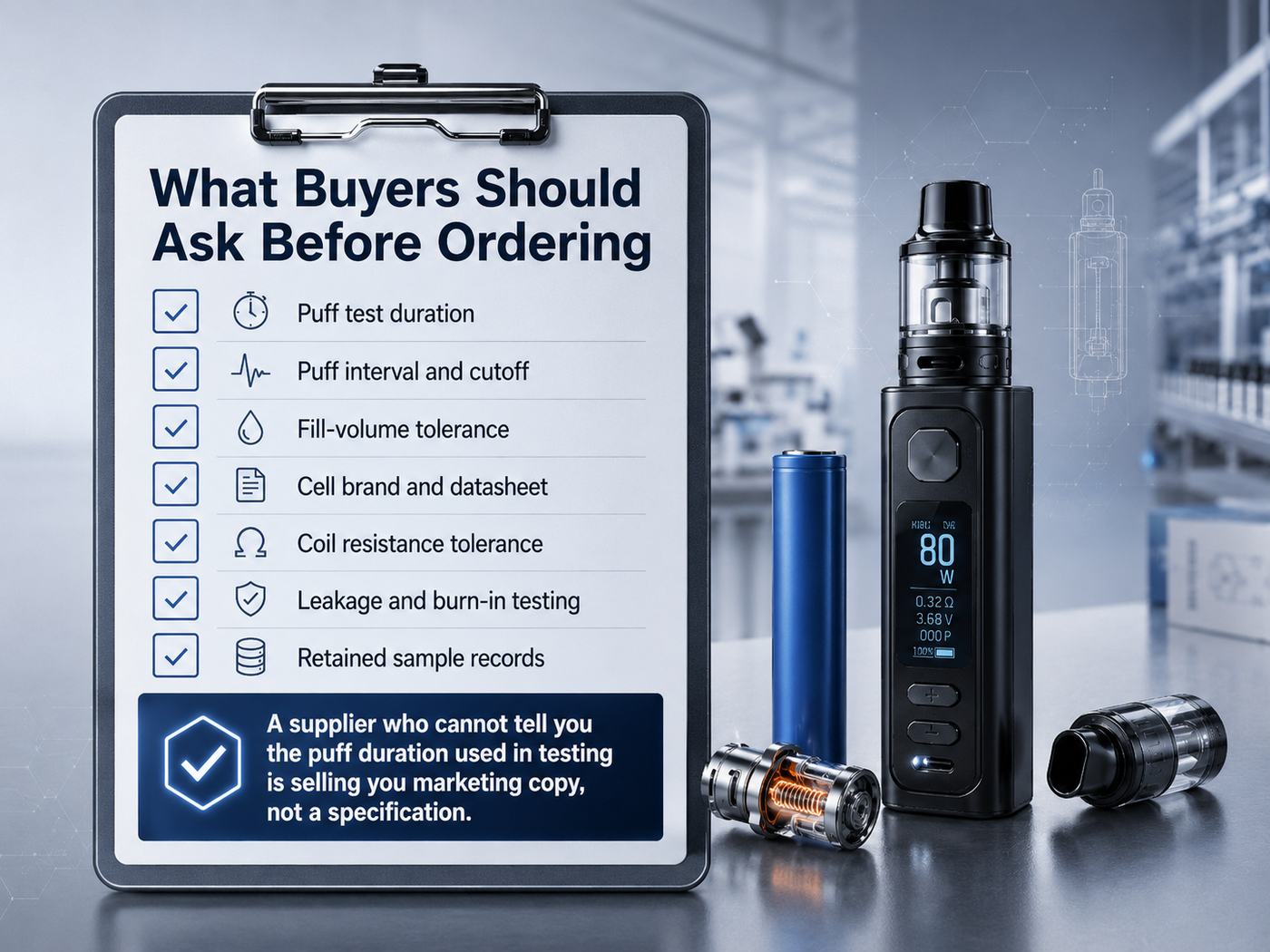
Figure 1. Buyer checklist for validating puff-count claims before sample approval.
The risk is not asking too many questions. The risk is trusting a number before you know how it was produced.
Before a buyer accepts any puff count vape claim, the supplier should be able to answer five questions without improvising:
What puff duration, interval, and cutoff setting were used in the test?
What is the batch-to-batch fill-volume tolerance, and how is it measured?
What cell brand, model, and capacity grade are used?
What discharge curve or voltage endpoint supports the advertised lifespan?
Was the coil tested against the actual flavor SKUs, or only a neutral liquid?
|
Any rechargeable disposable above 8,000 puffs without documented discharge curves is a liability, not a feature. The number is decoration until the test record exists. |
How Long Does a Disposable Vape Last?

Figure 2. Disposable vape lifespan depends on battery, e-liquid, coil behavior, and fill-volume control.
Disposable programs fail when the puff number is treated as a guarantee instead of a tested condition.
Puff Count Tiers and Real-World Use
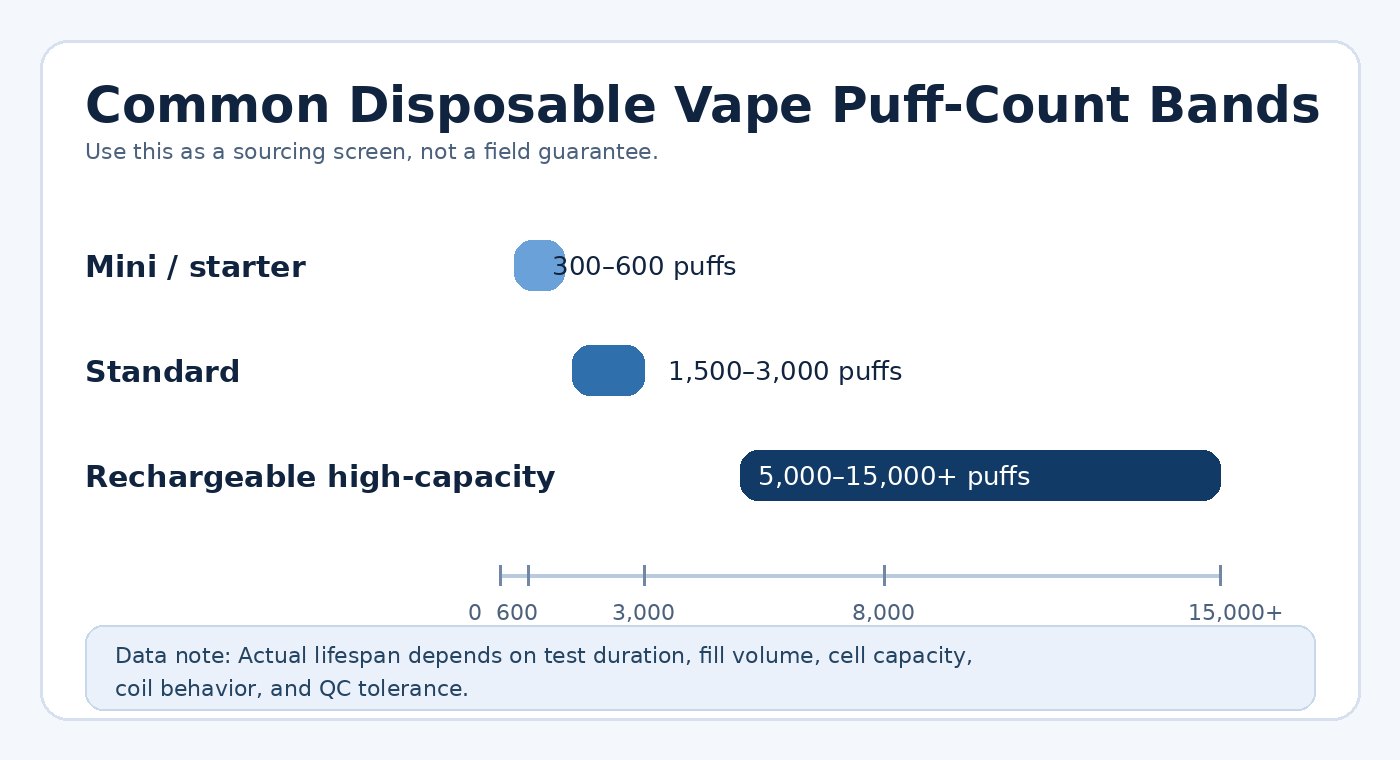
Most disposable programs fall into three commercial tiers: mini or starter units at about 300 to 600 puffs, mid-range units at about 1,500 to 3,000 puffs, and high-capacity rechargeable disposables at about 5,000 to 15,000+ puffs.
Public product specs show the spread. ELFBAR lists the BC5000 Ultra at up to 5,000 puffs with a 650 mAh battery. GEEK BAR lists the Pulse at 15,000 puffs in regular mode and 7,500 in pulse mode. Those examples are useful because they show how far the category has moved from small single-cycle disposables. [1][2]
The test protocol matters more than the headline. Many factory puff tests are calibrated around short machine puffs, often roughly 1.0 to 1.5 seconds. Real users may draw for 2 to 3 seconds, then take repeated puffs with little cooling time. That changes liquid consumption, heat load, and battery drain.
|
Do not buy the largest number on the box. Buy the test protocol that supports it. |
Battery, E-Liquid, and QC as Limiting Factors
A good disposable design tries to balance e-liquid volume with usable battery capacity. If the battery dies while liquid remains, users complain about wasted juice. If the reservoir dries while the battery still fires, the complaint becomes burnt taste.
At scale, the average spec is not enough. A fill-volume drift of plus or minus 0.1 ml, uneven cotton pre-saturation, cell-capacity spread, or loose draw-sensor calibration can make one carton feel different from the next. Mesh coils help with heat distribution, but they do not erase poor wicking or overly sweet liquid design.
|
A high puff count with a weak endpoint definition is not a performance claim. It is shelf art. |
How Long Does a Vape Pod / Pod System Last?
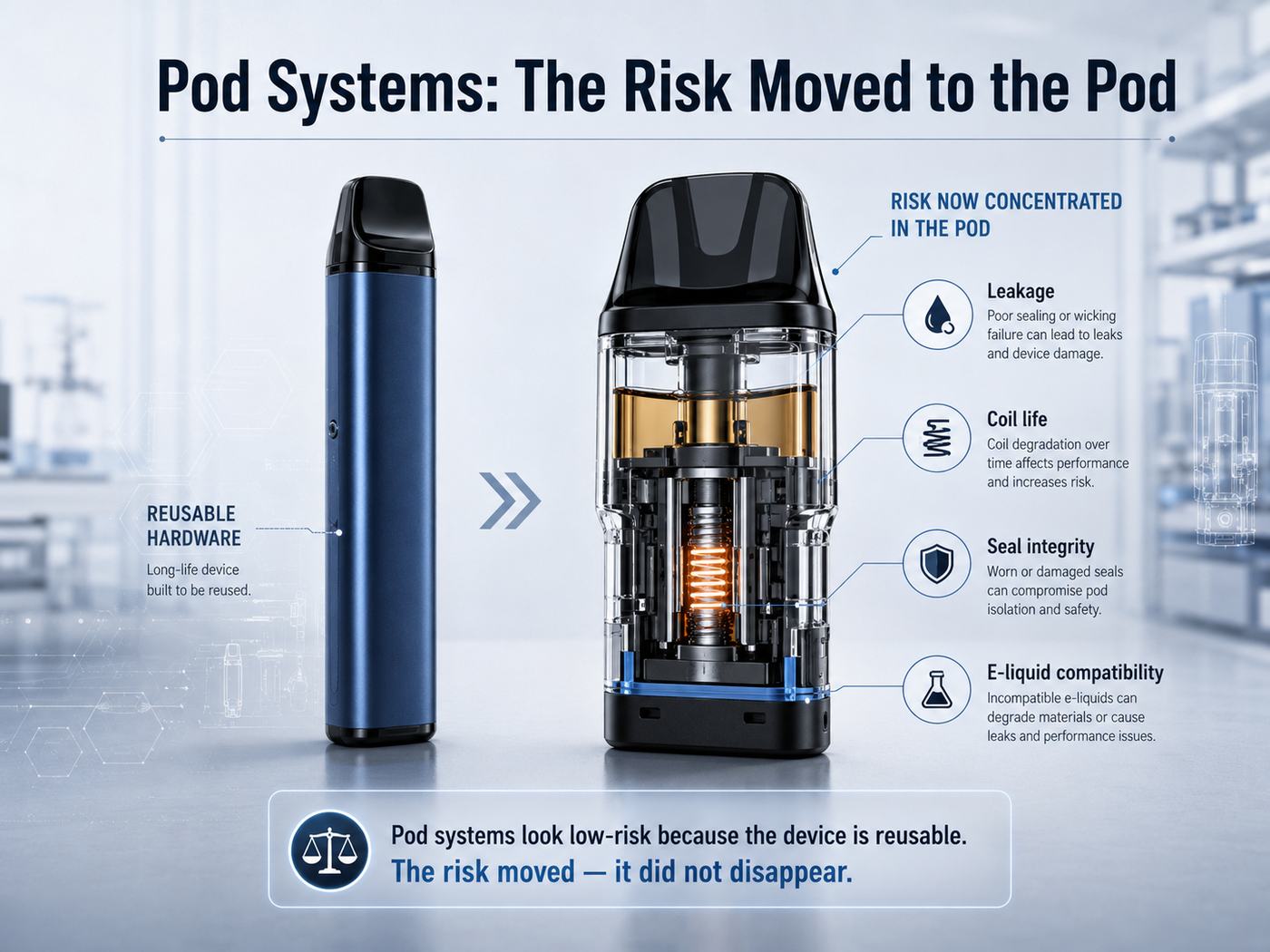
Figure 3. Pod systems move lifecycle risk from the reusable device into the pod, seals, coil, and liquid compatibility.
Pod systems look low-risk because the device is reusable. The risk moved, not disappeared. It is now concentrated in the pod.
A typical pod system battery sits around 400 to 1,200 mAh. Current compact systems often land near 1,000 mAh. VAPORESSO lists the XROS 4 Mini with a 1,000 mAh battery and a 0.4 ohm pod, with US market pod options noted separately. The XROS platform also supports multiple pod resistance levels across the series. [3]
Under normal charging behavior, many Li-ion battery devices are planned around roughly 300 to 500 full charge cycles. In the field, that often means one to two years of regular use before noticeable capacity decline, assuming the connector, board, and button system hold up.
Pods and coils move faster. Average users may get one to three weeks from a pod or replaceable coil. A lightly sweetened 50/50 nicotine-salt liquid at modest wattage may run longer. A dark, sucralose-heavy liquid can flatten flavor and coat the coil much faster.
Replaceable-coil pods can lower cost per use and appeal to experienced users. Prebuilt coil pods are simpler for mainstream buyers, but they make pod consistency central to repeat purchase behavior. If a pod burns early or leaks, the consumer rarely blames architecture. They blame the logo on the box.
|
Sucralose-heavy formulas and mesh coils are not a neutral combination. If your flavor lineup runs sweet, coil life should be validated specifically against those SKUs, not assumed from a generic test. |
How Long Does a Vape Pen or Box Mod Last?
Longer service life does not remove failure risk. It changes where failures happen.
A simple vape pen may use a 1,000 to 1,500 mAh internal battery. A regulated mod may run on one or two 18650 or 21700 cells, with output ranging from modest mouth-to-lung settings to high-power direct-lung use. VAPORESSO lists the GEN 200 MOD as a dual-18650 device with 5 to 220 W output. [4]
This category cannot be judged by puff count alone. Battery quality is the main variable behind long-term reliability. Name-brand cells from suppliers such as Samsung, Murata, and Molicel tend to provide tighter capacity and discharge behavior than generic cells. Murata's US18650VTC6 datasheet, for example, lists a 3,000 mAh minimum rated capacity and 3.6 V nominal voltage. [5]
Coils and atomizers remain consumables. Many replaceable coils last one to four weeks, depending on wattage, liquid, and user behavior. Mesh coils often keep wicking and heat distribution more even than older round-wire designs, but high wattage still shortens the maintenance cycle.
The chassis can last two to four years with solid build quality. The weak points are usually less dramatic than a total failure: intermittent firing, worn buttons, loose battery doors, 510 connector wear, screen faults, or firmware quirks.
|
A mod program built around generic cells may pass a sample check and still lose buyer trust through uneven cycle life. |
Key Factors That Affect How Long a Vape Lasts
Most lifespan disputes are not caused by one bad component. They are caused by variables nobody validated together.
E-liquid composition. High-VG liquids are thicker and can slow wicking in small channels. Sweeteners, especially sucralose-heavy formulas, leave deposits on coils. Acidic or cooling-heavy systems may also stress seals and shift flavor stability.
Puff frequency and duration. A device tested with short, cool machine puffs will not behave the same for users taking repeated three-second draws. Chain vaping raises coil temperature, stresses the wick, and drains the cell faster.
Battery quality and cell chemistry. Li-ion and LiPo packs can both work well, but capacity tolerance, internal resistance, protection circuitry, and supplier grading shape real vape battery life.
Coil resistance and wattage calibration. Lower resistance and higher wattage create more vapor but consume more liquid and energy per puff. A 0.4 ohm pod and a 1.2 ohm pod do not age the same way.
Manufacturing tolerances. Fill accuracy, cotton density, coil placement, solder quality, airflow sealing, and draw-sensor calibration all affect how long a vape lasts in a user's hand.
Storage conditions. Heat is the quiet inventory killer. E-liquid darkens faster, nicotine oxidizes faster, seals age faster, and lithium cells lose usable capacity faster in hot warehouses.
|
The factor buyers miss is interaction risk. A sweet formula, a warm warehouse, and a low-resistance coil can each pass alone and fail together. |
Comparison Table: Vape Lifespan by Device Type
A table can hide as much as it reveals if buyers treat it as a promise instead of a sourcing screen.
Use the comparison below to frame supplier conversations. The ranges reflect common market formats and public product examples, but each SKU still needs its own protocol, record set, and endpoint definition.
|
Device Type |
Common Puff / Lifecycle Range |
Battery Capacity |
Avg Coil / Pod Life |
Key Failure Mode |
Device Lifespan |
|---|---|---|---|---|---|
|
Mini Disposable |
300 to 600 puffs |
280 to 400 mAh |
Built-in, single lifecycle |
Battery or fill depletion before claimed endpoint; dry hits near end of life |
Until depleted |
|
Standard Disposable |
1,500 to 3,000 puffs |
400 to 650 mAh |
Built-in, single lifecycle |
Fill variance, wick dry-out, draw-sensor inconsistency |
Until depleted |
|
Rechargeable Disposable |
5,000 to 15,000+ puffs |
500 to 800 mAh |
Built-in, reservoir-limited |
Reservoir or coil exhaustion before battery; weak discharge curve; charging-port issues |
Until e-liquid or coil expires |
|
Pod System |
Usage-dependent |
400 to 1,200 mAh |
1 to 3 weeks per pod or coil |
Pod leakage, burnt coil, connector wear, battery cycle decline |
1 to 2 years for device unit |
|
Vape Pen |
Usage-dependent |
1,000 to 1,500 mAh |
1 to 4 weeks |
Internal battery degradation, button or connector wear, coil burnout |
1 to 3 years |
|
Box Mod |
Usage-dependent |
One or two 18650/21700 cells |
1 to 4 weeks |
Cell quality, 510 wear, battery-door looseness, PCBA or firmware faults |
2 to 4 years |
Data note: Ranges reflect common market SKU classes and should be confirmed against exact product design, supplier test protocol, and target-market rules.
Vape Shelf Life: How Long Can Vapes Sit in Inventory?
Inventory turns a technical problem into a cash problem.
Unopened disposables are often treated as 12 to 24 month products when stored properly: cool, dry, away from direct light, and ideally around 15 to 25 C. The twin enemies are e-liquid oxidation and battery self-discharge.
Battery University lists 15°C as a recommended storage temperature for most batteries and notes that self-discharge rises with age, cycling, and elevated temperature. Those points matter because a vape product is not a bare cell in a lab drawer. A pre-charged disposable also has a protection circuit, draw sensor, and board design that may add parasitic drain. [6][7]
Pod system devices usually tolerate inventory better because the device can often be recharged before sale or use. Pre-filled pods are more sensitive to seal quality, headspace oxygen, nicotine oxidation, and flavor volatility.
For wholesale buyers, overordering is not free. A lower unit cost can disappear if stock ages past peak flavor, arrives with weak activation, or forces discounting. MOQ, production cadence, regional demand, and temperature control belong in the lifespan conversation.
|
Cheap inventory gets expensive when it sits past its activation window. |
What Buyers and Brand Owners Should Actually Be Asking
The risk is not asking a hard question. The risk is discovering the answer after your retailer has complaints.
Sophisticated buyers do not stop at "What is the puff count?" They ask how the number was produced, what tolerance band surrounds it, and what happens when the product is used outside the machine-test condition.
What is your puff count test methodology, and at what puff duration?
What puff interval, cutoff time, airflow setting, and endpoint definition are used?
What is your batch-to-batch fill-volume tolerance?
What cell brand, model, and capacity grade are used, and can I see the spec sheet?
What is the coil resistance tolerance across production?
Which flavors were used in coil-life validation?
Do you run fill-weight verification, leakage aging, activation checks, and voltage-discharge testing before packing?
Can battery capacity, fill volume, coil resistance, cotton grade, or wattage curve be adjusted for our SKU?
These questions separate sourcing from shopping. A supplier selling commodity white-label inventory may not have confident answers. A serious manufacturing partner should have test records, retained samples, and pass-fail criteria.
|
A spec that cannot be verified before production will be argued after production. |
How Custom OEM/ODM Manufacturing Improves Vape Lifespan Consistency
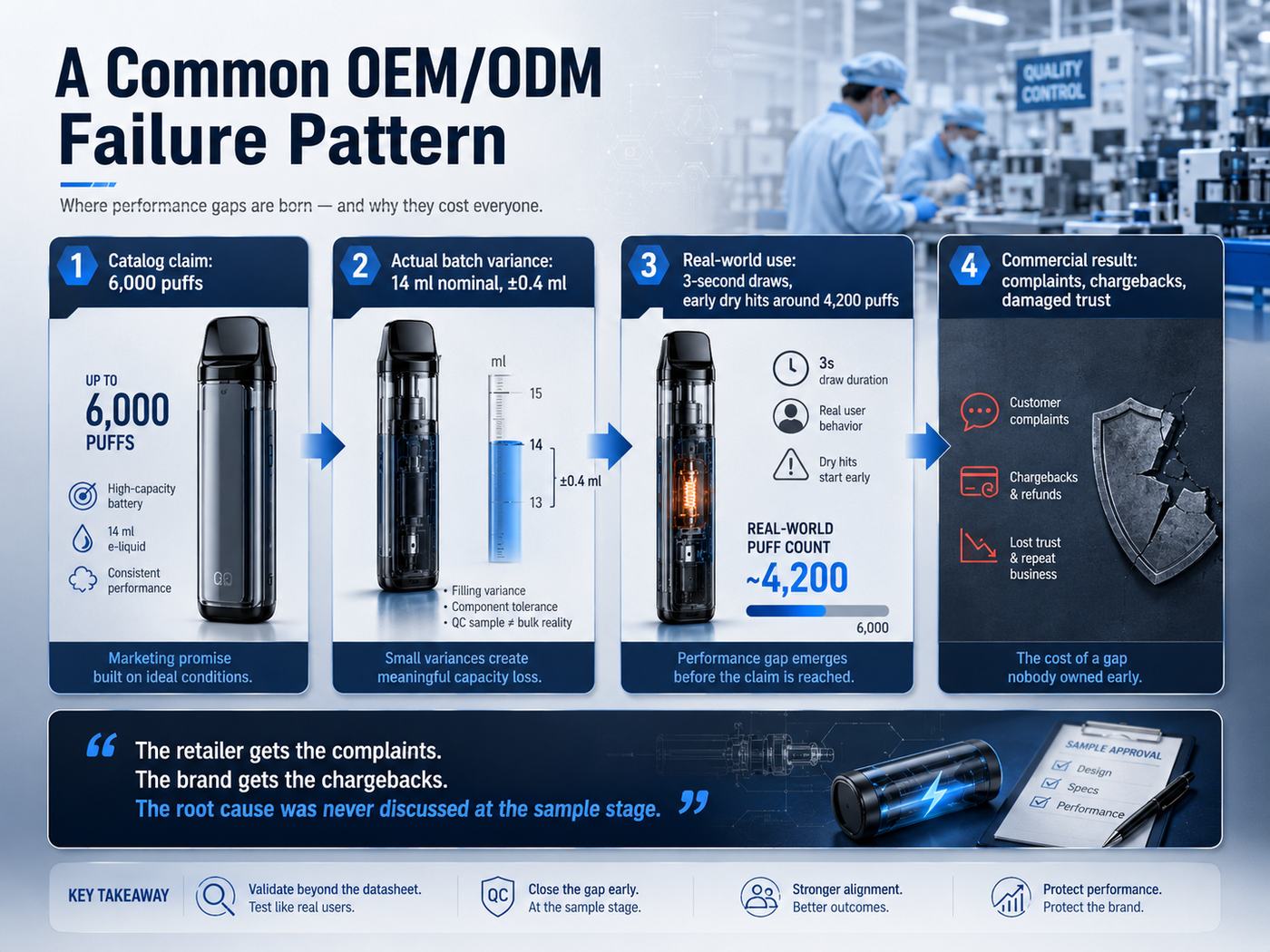
Figure 4. A common OEM/ODM failure pattern: small sample-stage tolerances can become retail-stage complaints.
OEM/ODM work matters most when a small tolerance turns into a commercial failure.
A common failure pattern looks like this: a brand sources a 6,000-puff rechargeable disposable on catalog terms. Fill volume is nominally 14 ml. Actual batch variance runs plus or minus 0.4 ml. At three-second real-world draws, the low-fill units start delivering dry hits around 4,200 puffs.
The retailer gets the complaints. The brand gets the chargebacks. The root cause, fill tolerance, was never discussed at the sample stage.
That is the practical value of OEM vape customization. The conversation shifts from "What does your catalog claim?" to "What must this SKU pass before production?" Battery capacity, e-liquid fill, coil resistance, mesh geometry, cotton grade, airflow path, firmware cutoff, and wattage curve can all be specified around the target lifespan.
Custom vape manufacturing also changes the QC record. Automated puff testing, fill-weight verification, incoming cell checks, voltage-discharge curves, leakage aging, activation testing, and retained batch samples are not paperwork. They are the controls that keep a lifespan claim from turning into a retailer dispute.
White-label speed can be useful for market testing. White-label ambiguity is expensive when the SKU moves into volume. The brands that scale without fighting the same quality complaints every quarter are not luckier. They asked better questions at the sample stage.
|
White-label speed is useful. White-label ambiguity is expensive. |
Buyers who understand how long does a vape last make better sourcing decisions because they stop treating lifespan as a single number. They specify the parts that produce it.
Share your target puff count, fill volume, battery architecture, coil resistance, e-liquid style, and compliance market before the purchase order is locked. Use the OEM/ODM inquiry form, attach your current SKU spec, and ask for a sample-stage lifespan review.
Lifespan is specified before production or recovered after complaints. The brands we work with have learned it is much cheaper to do it in the right order.
Appendix: Copy/Paste Supplier Lifespan Checklist
Puff-test duration, interval, cutoff, and endpoint definition
Batch fill-volume tolerance and fill-weight verification method
Cell brand, model, capacity grade, and incoming QC criteria
Voltage-discharge curve and activation-voltage threshold
Coil resistance tolerance across production
Flavor-specific coil-life validation for sweet, dark, cooling, and high-VG SKUs
Leakage aging, activation testing, and retained sample policy
Approved adjustment range for battery capacity, fill volume, coil spec, cotton grade, and wattage curve
Source Notes
[1] ELFBAR BC5000 Ultra product page: https://www.elfbar.com/product/ELFBAR-BC5000-ULTRA-Disposable-Pod-Device.html
[2] GEEK BAR Pulse product page: https://jp.geekbar.com/product/pulse.html
[3] VAPORESSO XROS 4 / XROS 4 Mini product specifications: https://www.vaporesso.com/series-product/xros-series/xros4 and https://www.vaporesso.com/series-product/xros-series/xros4-mini
[4] VAPORESSO GEN 200 product specifications: https://store.vaporesso.com/products/gen-200
[5] Murata US18650VTC6 product datasheet: https://www.murata.com/-/media/webrenewal/products/batteries/cylindrical/datasheet/us18650vtc6-product-datasheet.ashx
[6] Battery University BU-702, How to Store Batteries: https://www.batteryuniversity.com/article/bu-702-how-to-store-batteries/
[7] Battery University BU-802b, What does Elevated Self-discharge Do?: https://www.batteryuniversity.com/article/bu-802b-what-does-elevated-self-discharge-do/