


Blog


Can You Bring Vapes on a Cruise? ——The Complete 2025 Guide for Travelers and Vape Brands
Written by EC-TIMES OEM Strategy Team

A vape brand buyer is packing samples for a distributor meeting at the cruise terminal; a traveler is doing the same with a refillable pod before boarding. At the last moment, both realize the same risk: the ship, airline, and port may not treat a vape like an ordinary pocket device. The core answer is clear: nicotine vapes are usually allowed on cruise ships, but use is restricted to designated smoking areas, and battery handling rules still apply before you ever reach the gangway.
The Short Answer: What Cruise Lines Actually Allow
Most major cruise lines treat e-cigarettes and vaping devices as smoking products. They are typically permitted on board for personal nicotine use, but vaping is restricted to designated smoking areas and is prohibited in cabins, balconies, dining venues, theaters, and most indoor public spaces.
|
Cruise line |
Official vape / e-cigarette position |
Where vaping is allowed |
Enforcement consequences |
|
Royal Caribbean |
Electronic vaping, including e-cigarettes, vapes, and mods, is covered by the smoking policy and permitted only in designated smoking areas. |
Marked smoking areas; exact locations depend on ship signage. |
Stateroom or balcony violations can trigger a cleaning fee and may be subject to further actions. |
|
Carnival Cruise Line |
Carnival limits smoking to designated areas, never staterooms or balconies, and expressly includes vaporizers and electronic cigarettes. |
Ship-specific outdoor areas and, on some ships, limited casino areas when seated and playing. |
Smoking in undesignated areas, including staterooms and balconies, results in a $500 charge per violation. |
|
Norwegian Cruise Line |
NCL lists electronic cigarettes and vapor devices in its smoking policy and prohibits them in staterooms and on balconies. |
Designated outdoor areas vary by ship; some casino areas allow e-cigarettes or vapor devices under specific conditions. |
Smoking inside a stateroom or on a balcony results in a cleaning charge; damage charges may apply if burns are detected. |
|
MSC Cruises |
MSC says smoking, including e-cigarettes, is not permitted in cabins, on cabin balconies, or anywhere not expressly indicated by signage and ashtrays. |
Marked smoking areas; casinos may be an exception during opening hours for seated guests who are playing. |
MSC reserves the right to levy a fee for smoking in non-designated areas; repeated non-compliance can lead to disembarkation. Port-country rules may also trigger confiscation or fines ashore. |
For vape brands, these policies share a common signal: travel products must help users comply before they board. Clear carry-on battery guidance, device-lock instructions, upright pod packaging, conservative use warnings, and market-specific port-of-call notes reduce consumer confusion and distributor risk. The commercial opportunity is not to claim cruise approval; it is to build SKUs that behave predictably under travel conditions and explain the rules plainly.
Battery rules are often shaped by the trip to the ship. The U.S. TSA lists electronic cigarettes and vaping devices as carry-on items only, not checked-bag items. IATA guidance says travelers should keep phones, laptops, cameras, vapes, and other battery-powered items in hand baggage, and the FAA gives the same practical message for flights: keep vapes in the cabin, protect them from accidental activation, and never use or charge them on the aircraft.

Sources: Royal Caribbean official policy; Carnival drug-free and smoking enforcement guidance; Carnival ship-specific smoking locations; Norwegian Cruise Line smoking policy; MSC Cruises onboard information FAQ; TSA electronic cigarettes and vaping devices guidance; IATA lithium battery passenger guidance; FAA PackSafe guidance
Why Cruise Ships Have Strict Rules About Vapes (And Why It Matters to Manufacturers)
A cruise ship is a moving hotel, port facility, restaurant complex, and power system operating in a confined marine environment. Operators are conservative about smoke, vapor, heat sources, batteries, and passenger behavior because a small incident can affect many people.
The maritime safety framework reinforces that caution. The International Maritime Organization explains that SOLAS Chapter VII governs dangerous goods and that the IMDG Code sets requirements for packing, container traffic, stowage, and segregation of dangerous goods in packaged form. Passenger-carried nicotine vapes are not handled like a commercial container of lithium batteries, but ship operators use the same safety mindset: reduce ignition points, keep risky behavior out of cabins, and keep incidents where crew can respond.
Three product risks matter most.
First, fire risk. A vape has a heating element and a lithium cell. If a device auto-fires in a bag, is damaged by impact, or is charged with an unsuitable cable, heat can build quickly. In a cabin, that risk is harder to see. In a marked smoking area, crew can monitor behavior and response is faster.
Second, battery quality. A weak cell, poor soldering, missing short-circuit protection, or inconsistent charging control can turn a travel product into a recall problem. For OEM and ODM programs, battery sourcing is not a purchasing detail. It is a compliance and brand-liability issue.
Third, leakage. Cruise travelers often fly before boarding, move between hot ports and air-conditioned cabins, and store devices horizontally in small bags. Pressure change, heat, low-viscosity e-liquid, and poor pod sealing can lead to seepage through the mouthpiece, airflow path, or filling plug.
A capable manufacturer addresses this before mass production. Leakage resistance can be improved through tighter silicone seal tolerances, pod-to-battery fit control, airflow isolation, condensation traps, controlled filling volume, material compatibility testing, and packaging that keeps pods upright. The best travel SKUs are not just smaller. They are built for movement, temperature shifts, and user misuse.
Sources: IMO IMDG Code overview
Battery Safety Standards You Need to Know: UN 38.3 and Beyond

UN 38.3 is one of the most important battery transport standards for vape brands. Buyers often ask for “UN 38.3 certification,” but the practical requirement is evidence that the lithium cells or batteries have passed UN Manual of Tests and Criteria, Sub-section 38.3 testing, along with a valid test summary or report package.
PHMSA, the U.S. Pipeline and Hazardous Materials Safety Administration, states that lithium batteries must undergo design tests under UN Manual Sub-section 38.3 for safety, and it provides guidance on lithium battery test summaries for manufacturers and distributors.
Testing providers describe the scope in practical terms: TÜV SÜD lists altitude simulation, thermal test, vibration, shock, external short circuit, impact, overcharge, and forced discharge, while Intertek treats UN 38.3 as transport testing for lithium batteries across the supply chain.
For vape buyers, this changes the supplier checklist. It is not enough for a factory to say “battery compliant.” A serious OEM/ODM partner should be able to provide cell supplier traceability, UN 38.3 documentation, incoming quality inspection records, charging-cycle test logic, and battery protection design details.
The battery management system, or BMS, is part of that story. In compact vape devices, BMS functions may be integrated into a protection IC, charging IC, MOSFET circuit, or MCU-based control board. The goal is straightforward: prevent overcharge, over-discharge, short circuit, excessive current, and unsafe activation.
Airline rules make the commercial point even clearer. IATA guidance lists 100 Wh as the general carry-on threshold for many lithium-ion batteries and says e-cigarettes or vapes, when permitted by an airline, must not be used or charged during the flight. The typical vape device sits far below large power-bank capacity, but the regulatory concern is failure behavior. A small cell that is poorly sourced or poorly protected can still create smoke, heat, or fire.
Sources: PHMSA Lithium Battery Test Summaries guidance; TÜV SÜD UN/DOT 38.3 testing overview; Intertek UN 38.3 testing overview; IATA lithium battery passenger guidance
Cruise-Friendly Vape Design: What Smart Brands Are Already Doing
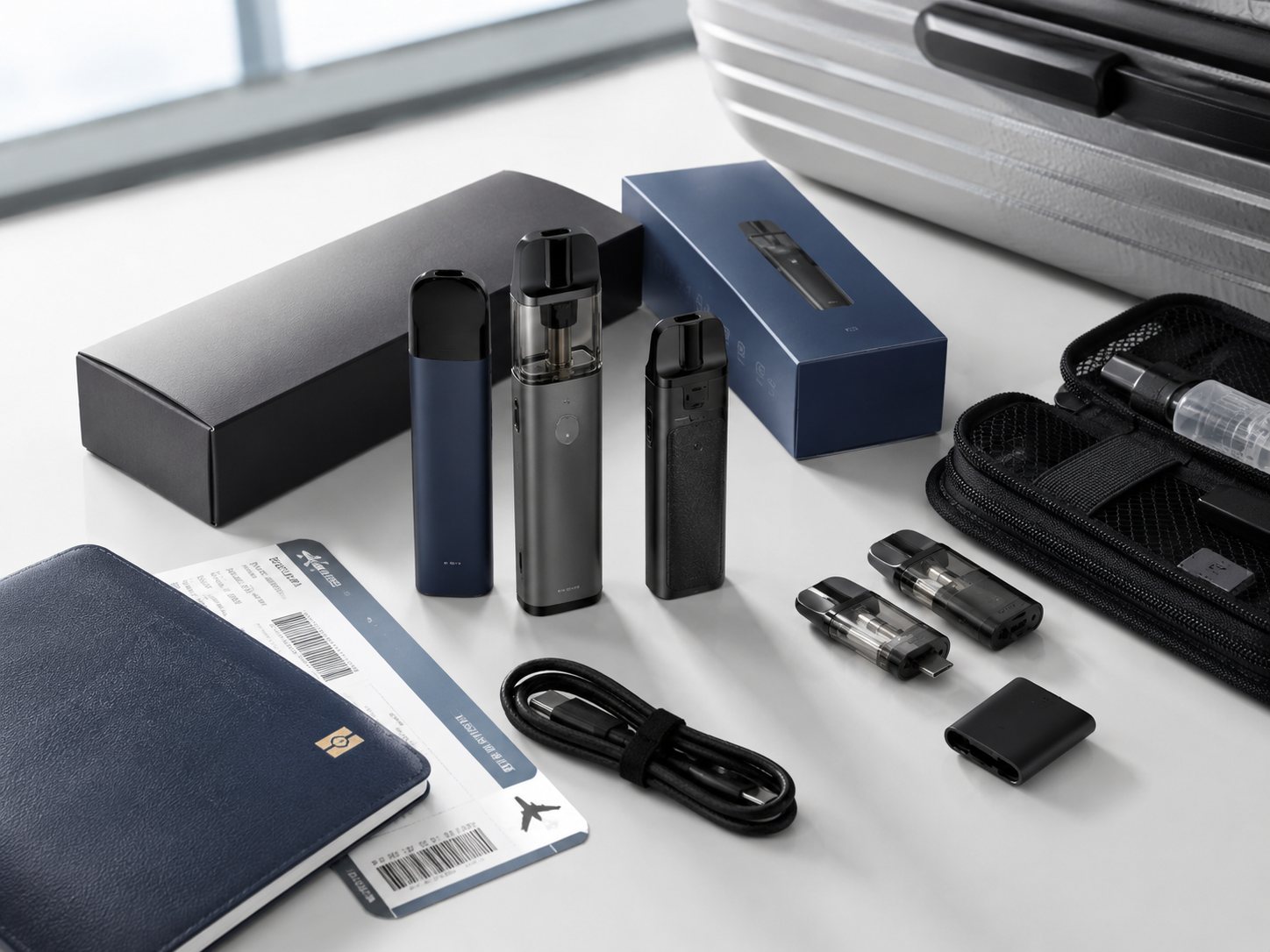
The label 'cruise-friendly' carries real design weight for serious brands. For responsible brands, it means a vape SKU designed for travel restrictions, consumer handling, and regional compliance.
The first design move is capacity planning. For EU-targeted products, the European Commission states that Article 20 of the Tobacco Products Directive sets safety and quality requirements for e-cigarettes, including maximum nicotine concentration and volume for cartridges, tanks, and nicotine liquid containers. EUR-Lex summaries of the Directive’s e-cigarette rules specify the familiar TPD limits: e-liquids not above 20 mg/ml nicotine, tanks and cartridges not larger than 2 ml, and refill containers not larger than 10 ml. For U.S. programs, the design brief is different: FDA states that new tobacco products need a written marketing order to be legally marketed, and PMTAs are reviewed against a public-health standard for the population as a whole.
This is why global brands often split travel SKUs by market. A 2 ml pod system may be logical for TPD countries. A U.S.-focused SKU may require documentation built around the PMTA pathway, materials control, aerosol data, abuse testing, and youth-access risk controls. A cruise retail or duty-adjacent concept may need conservative labeling, clearer use warnings, and packaging that keeps the device stable in luggage.
The second design move is leakage resistance. A travel-ready pod should survive horizontal storage, temperature swing, and vibration without liquid entering the airflow tube. Engineering details matter: plug compression, weld consistency, center-post geometry, ceramic-core sealing, cotton saturation range, and e-liquid viscosity all affect field performance.
The third design move is battery assurance. A buyer should ask where the cell comes from, whether the cell has UN 38.3 test evidence, how the factory prevents cell substitution, and how finished devices are screened. Strong production controls include barcode-level battery traceability, charge/discharge sampling, aging tests, short-circuit protection checks, and random teardown audits.
The fourth design move is user instruction. A travel SKU should tell consumers to keep vapes in carry-on baggage when flying, protect the device from accidental activation, avoid charging on aircraft, follow ship signage, and check port-of-call rules. This reduces complaints and shows distributors that the brand understands real travel behavior.
For OEM and ODM buyers, supplier selection becomes strategic. A factory that can design a leak-resistant pod, source documented cells, adjust pod capacity for TPD markets, and support PMTA-oriented documentation will save time before tooling, not only after a shipment is delayed.
Sources: European Commission e-cigarettes page; EUR-Lex / Directive 2014/40/EU reference; FDA Tobacco Products Marketing Orders page
Practical Tips for Travelers Carrying Vapes on a Cruise

Check the cruise line’s current smoking policy before departure. Search by ship name, not only by cruise brand, because designated areas can vary across a fleet. Carnival, for example, publishes ship-specific smoking locations and notes that outdoor smoking is not allowed during embarkation or debarkation while the ship is refueling.
Pack the device in your carry-on if you are flying to the port. Do not put the vape or loose lithium batteries in checked luggage. TSA, FAA, and IATA guidance all point toward cabin carriage with protection against accidental activation.
Keep the device protected. Use a case, turn the device off when possible, avoid loose metal contact with battery terminals, and do not travel with a swollen, punctured, overheated, or damaged device. IATA advises travelers not to travel with swollen, punctured, or damaged batteries.
Store e-liquid carefully. Keep bottles upright, use sealed bags, avoid overfilled tanks, and leave a little air space when filling refillable pods before travel. If you are carrying multiple pods, keep them in retail packaging or a rigid organizer.
Do not vape in your cabin or on your balcony. Carnival and NCL both publish specific financial penalties for cabin or balcony smoking violations, and MSC says repeated non-compliance can lead to disembarkation.
Do not assume port rules match ship rules. MSC’s FAQ reminds guests that use and import of vapes may be restricted in certain countries and tells guests to check national restrictions when going ashore.
Keep cannabis or THC cartridges out of the travel plan. Cruise operators may apply federal, flag-state, port-state, and company drug policies even when a passenger comes from a jurisdiction where cannabis is legal. Carnival’s drug-free guidance expressly includes marijuana in the smoking enforcement language for ships.
For travelers, the safest routine is simple: carry it properly, use it only where signage allows, protect the battery, and check the destination. For vape brands, these tips are consumer research. Every behavior above can be translated into packaging copy, accessory design, product testing, and SKU planning.
Sources: Carnival ship-specific smoking locations; TSA electronic cigarettes and vaping devices guidance; FAA PackSafe guidance; IATA lithium battery passenger guidance; Carnival drug-free and smoking enforcement guidance; Norwegian Cruise Line smoking policy; MSC Cruises onboard information FAQ
The Bottom Line for Vape Brands and Buyers
The answer to “can you bring vapes on a cruise” is yes in most mainstream cruise scenarios for nicotine devices, but with strict limits on where they can be used, how they should be packed for flights, and what may happen at ports. The stronger B2B lesson is that travel use is not an edge case anymore. It is a design requirement.
A cruise-friendly vape product needs more than a compact shell. It needs leakage-resistant pod architecture, documented lithium cell sourcing, UN 38.3 test evidence, battery protection design, clear travel instructions, and market-specific compliance planning. For Europe, that can mean TPD-ready pod capacity and labeling discipline. For the United States, it means design records and product controls that can support the PMTA pathway rather than undermine it.
If your brand is planning a travel-size vape SKU, a cruise retail concept, or a region-specific pod system, our OEM/ODM team can support the full technical brief: industrial design, leak-resistant structure, compliant pod capacity, UN 38.3 cell documentation, BMS design review, packaging warnings, and production quality control. Product-line planning cycles and compliance review windows are getting tighter, especially when a buyer needs separate SKUs for the EU, U.S., and travel retail channels. Bring us the target market, expected retail channel, battery capacity target, pod volume, nicotine-strength range, and launch schedule. We will translate travel restrictions into a clear product specification your distributors and compliance team can act on.
Source URLs / 来源链接
Royal Caribbean official policy: https://www.royalcaribbean.com/faq/questions/onboard-smoking-policy
Carnival drug-free and smoking enforcement guidance: https://help.carnival.com/app/answers/detail/a_id/6123/~/drug-free-zones
Carnival ship-specific smoking locations: https://help.carnival.com/app/answers/detail/a_id/3490/~/locations-where-you-can-smoke
Norwegian Cruise Line smoking policy: https://www.ncl.com/ca/en/cruise-faq/smoking
MSC Cruises onboard information FAQ: https://www.msccruisesusa.com/faq/on-board-information
TSA electronic cigarettes and vaping devices guidance: https://www.tsa.gov/travel/security-screening/whatcanibring/items/electronic-cigarettes-and-vaping-devices
IATA lithium battery passenger guidance: https://www.iata.org/en/youandiata/travelers/batteries/
FAA PackSafe guidance: https://www.faa.gov/hazmat/packsafe/e-cigarettes-vaping
IMO IMDG Code overview: https://www.imo.org/en/ourwork/safety/pages/dangerousgoods-default.aspx
PHMSA Lithium Battery Test Summaries guidance: https://www.phmsa.dot.gov/training/hazmat/new-un-requirement-test-summaries
TÜV SÜD UN/DOT 38.3 testing overview: https://www.tuvsud.com/en-us/industries/mobility-and-automotive/automotive-and-oem/automotive-testing-solutions/battery-testing/un-dot-38-3
Intertek UN 38.3 testing overview: https://www.intertek.com/batteries/un-38-3-testing/
European Commission e-cigarettes page: https://health.ec.europa.eu/tobacco/product-regulation/electronic-cigarettes_en
EUR-Lex / Directive 2014/40/EU reference: https://eur-lex.europa.eu/legal-content/EN/TXT/HTML/?uri=CELEX%3A32014L0040
FDA Tobacco Products Marketing Orders page: https://www.fda.gov/tobacco-products/market-and-distribute-tobacco-product/tobacco-products-marketing-orders